Partial EB‑5: Splitting Your Investment to Secure a Priority Date
Understanding the Strategy
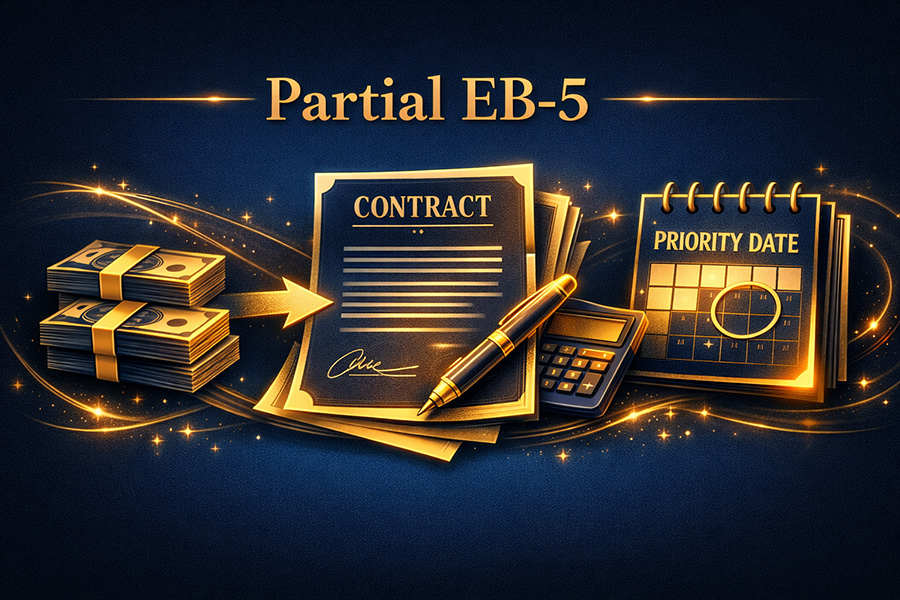
When you first hear about the EB‑5 program, you might assume you must wire all US$800 000 at once. In reality, some investors are looking to file earlier than their finances allow. That’s where the partial EB‑5 strategy comes in. By depositing an initial portion of your capital and signing a binding promissory note for the remainder, you can file your I‑526E petition and lock in a priority date while you gather the balance of funds.
How It Works
- Make a partial capital contribution: Start by depositing a significant portion of your investment – often US$200 000 to US$300 000. This initial amount shows commitment and demonstrates that you are “in the process of investing.”
- Sign a subscription agreement or promissory note: You enter into a binding contract that obligates you to contribute the remaining capital. The agreement must be enforceable and include a clear payment schedule.
- File your I‑526E petition: Once the initial deposit is made and the promissory note executed, you can file your EB‑5 petition and fix your priority date. This locks in your place in line for a visa.
- Complete funding according to schedule: You deposit the remaining investment according to the agreed‑upon timeline – often over 6–12 months. The capital must be irrevocably committed and at risk for job creation.
When It’s Legitimate – and When It’s Not
Partial funding isn’t a loophole; it’s a strategy that can be legitimate if used correctly. To be approvable, your petition must show that:
- You make a meaningful initial investment, not just pay administrative fees.
- The promissory note is binding, enforceable and backed by assets or income that will cover the remainder.
- The funds are truly at risk and slated for deployment in the job‑creating enterprise.
- Your personal finances can support the full investment; partial funding isn’t for those hoping to raise capital later.
Be wary of any regional center that markets “cheap priority dates” or implies you can deposit a token amount and never finish funding. USCIS expects the entire investment to be on its way to the project. Delays or a failure to fulfill the commitment will lead to denial.
Key Questions to Ask
- How is the initial deposit held? Is your partial contribution placed in escrow? When is it released—at I‑526E filing, at approval or upon full funding?
- What is the payment schedule? Are the remaining installments due in 6, 12 or 18 months? How does the timeline align with the project’s capital needs?
- What happens if I miss a payment? Does the agreement impose penalties or forfeit your initial deposit? Can the project draw interest or require collateral?
- How does USCIS view partial funding? Does the regional center have experience with these cases? Ask for examples of successful approvals.
- What if I never fund the remainder? Failure to complete your investment can result in petition denial and loss of priority date. Be sure you have a credible, lawful source for the remaining funds.
Why It Matters for Indian and Chinese Investors
Partial funding appeals to investors from backlogged countries like India and China because it locks in a priority date sooner. Retrogression (visa backlogs) means that filing a few months earlier can translate into years saved later. However, you must still fund the full investment on schedule; merely filing early won’t guarantee success if you fail to complete your capital commitment.
Best Practices
- Deposit a meaningful amount: An initial contribution of US$200–300 k shows USCIS you’re serious and reduces the risk of denial.
- Use a binding promissory note: The contract should spell out payment dates, collateral and consequences for missing deadlines.
- Align with the project timeline: Coordinate your payment schedule with the job‑creating entity’s funding needs so your money can be deployed on time.
- Maintain transparency: Disclose the full funding plan in your petition and provide evidence of lawful source for both the initial and future installments.
- Work with experienced professionals: Engage attorneys and regional centers with a track record in partial EB‑5 filings to avoid missteps.
Conclusion
The partial EB‑5 strategy allows qualified investors to file an EB‑5 petition early by making an initial deposit and committing to fund the balance later. When used responsibly—with a meaningful initial investment, a binding promissory note, and a credible plan for the remainder—it can be a valuable tool for investors seeking to lock in a priority date. However, this approach is not a shortcut; you must still commit the full US$800 000 (or US$1.05 million outside TEAs) and place it at risk. If you lack the financial means or rely on uncertain future funds, partial funding may set you up for failure. Approach this strategy with caution, ask the right questions and seek professional guidance to ensure your investment stays on the path to approval.