
The Big Short, Margin Call and EB-5: What Crisis Movies Teach EB-5 Investors
The Big Short and Margin Call are more than just great films. They are compact textbooks on how a financial system breaks when complex products, leverage and human incentives collide.
For foreign investors using the EB-5 Immigrant Investor Program as a path to a U.S. Green Card, these stories are not about “someone else’s mistakes in 2008”. They are a reminder that your $800,000+ lives in the same global financial ecosystem where CDOs and synthetic CDOs once exploded.
In this article, our EB-5 Wiki editorial team shares its view — and two fictional experts, Bob and March, discuss what is really happening and what lessons an EB-5 investor should take from these movies.
Recommended background reading from our Wiki
1. The Big Short: how $50M in mortgages became a financial “bomb”
In The Big Short, there is a famous scene where a pool of subprime mortgages worth roughly $50 million becomes the foundation for billions of dollars in bets via CDOs and synthetic CDOs. The real-economy risk is limited, but the financial overlay is massively leveraged and extremely opaque.
If we simplify what happens:
- real mortgage loans are pooled into mortgage-backed securities;
- these are sliced into “safe” and riskier tranches inside CDOs;
- then synthetic CDOs are built that do not even hold the loans themselves, but credit default swaps (CDS) — derivative bets on whether those loans default;
- the same underlying risk is effectively copied across the system many times.
Result: a relatively small shock in the underlying mortgages turns into a chain reaction for the whole financial system.
Expert dialogue: Bob & March on The Big Short
So the problem was not just bad mortgages?
Exactly. Bad mortgages were the match. The explosion came from the structures built around them — CDOs and especially synthetic CDOs.
In plain language, that is when you buy a beautiful “box” but have no idea what is inside?
That is it. And the more complex the box, the easier it is to hide risk and sell it as “almost risk-free yield”.
2. Margin Call: when the model breaks and clients are the last to know
In Margin Call, we see the crisis from inside a large investment bank. An analyst realizes that the risk model no longer works. The positions are so leveraged that even a modest shock could wipe out the firm’s capital.
Senior management gathers overnight and makes a cold, rational decision: dump the toxic portfolio on the market at the opening bell, before anyone fully understands how bad things are. The bank survives. Clients absorb the damage.
Expert dialogue: Bob & March on Margin Call
The most unsettling part of Margin Call is that the bank openly chooses to save itself, not its clients.
That is not Hollywood exaggeration. In real stress, big institutions will almost always prioritize the survival of the firm over the preservation of client portfolios.
And you are saying the EB-5 investor lives in the same world?
Yes. When a project comes under pressure, banks, developers and funds will think about themselves first. Your position in the capital stack determines whether anything is left for you.
3. Where EB-5 comes in: not an “immigration product”, but a real investment
EB-5 is often marketed as an “immigration product”: a Green Card through investment, passive participation, job creation.
From a financial perspective, however:
EB-5 is a normal investment into a real-world project — a hotel, an office tower, a mixed-use development, infrastructure — with its own debt, equity, creditors, covenants, refinancing risk and exposure to market cycles.
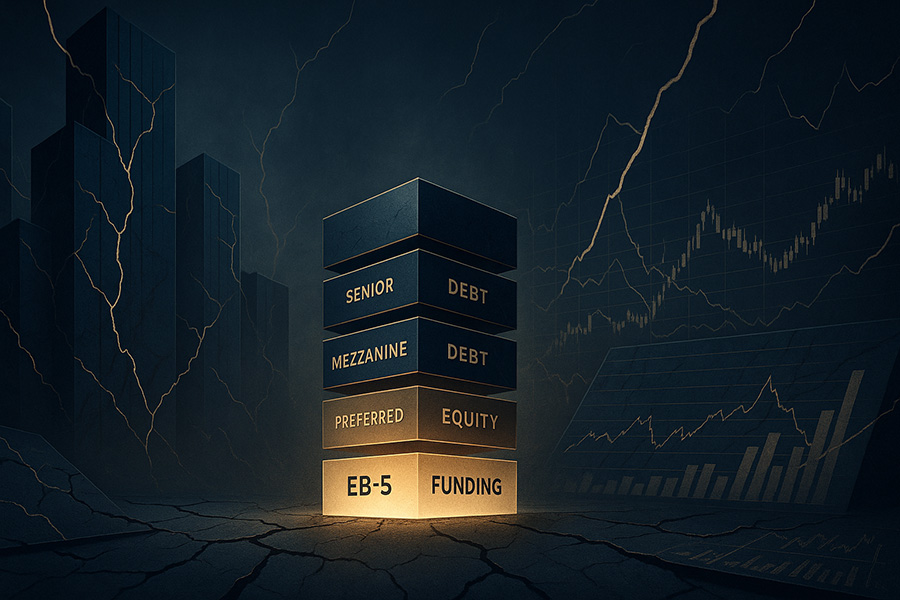
A typical capital stack might look like this:
- senior bank loan;
- mezzanine debt;
- EB-5 loan or preferred equity;
- developer’s equity.
If leverage is high, the EB-5 position often sits closer to the riskier layers. In a benign market, that may still work. In a stress scenario, this is precisely where losses concentrate — just as they did in the lower CDO tranches in 2008.
Related Wiki articles on structure and risk
Bob & March: the “immigration product” illusion
So when an investor only asks “will I get my Green Card?”, he is ignoring half the reality?
More than half. He ignores what actually determines the fate of both his money and the project.
And that is the main parallel with The Big Short?
Exactly. Back then, pension funds bought AAA tranches without understanding the subprime loans inside. In EB-5, many people sign up for a project without really examining the capital stack or the financing terms.
4. EB-5 risks through the lens of The Big Short and Margin Call
Where do the movie lessons map directly onto EB-5 reality?
4.1 Excessive project leverage
High loan-to-value (LTV) ratios, a large senior loan, and aggressive assumptions on revenue and occupancy all push EB-5 capital closer to a “junior tranche” role. In that position, even moderate underperformance can put repayment at risk.
We discuss financing and capital structure in more depth in Choosing a Regional Center: Key Factors to Consider.
4.2 Dependence on refinancing
Many projects rely on a familiar narrative: build the asset, stabilize operations, then refinance easily into long-term debt or exit through a sale.
This model works only in a healthy market. If interest rates stay high or the asset class (for example, offices or hotels) is under pressure, the refinancing moment can become a real-world margin call:
- the bank refuses to roll the loan on similar terms;
- new lenders demand more equity and stricter covenants;
- valuations fall just as debt needs to be repaid.
In that situation, EB-5 capital, sitting below senior lenders, can be among the first to feel the impact.
4.3 Information asymmetry
The developer and regional center always know more about the project than a foreign investor:
- construction delays and cost overruns;
- leasing problems and tenant negotiations;
- discussions with the senior bank about covenants or waivers.
In stress, they face a choice similar to the one in Margin Call:
- either admit the scale of the problem early and restructure honestly,
- or try to “buy time” — sometimes by attracting new investors before fully disclosing the risks.
Bob & March: service vs deal
So the most dangerous EB-5 investor is the one who believes he is buying a service, not entering a deal?
Exactly. He does not read the offering documents the way he would read a shareholders’ agreement or a loan contract.
How does he avoid becoming a character in the next crisis movie?
By treating EB-5 as an investment with real, quantifiable risks — and by using tools like the EB-5 Wiki, independent analysis and professional advice, not just marketing decks.
4.4 When a project actually fails
Sometimes the worst-case scenario happens: a project fails or goes into bankruptcy. That does not always mean automatic deportation, but it is a highly complex zone where immigration law and insolvency law collide.
Deep-dive risk materials
5. What changed by 2025–2026 — and why it still matters
Since the 2008 crisis, several things have improved:
- banks are generally better capitalized;
- securitization has become simpler and more transparent on paper;
- regulators now routinely talk about “systemic risk” and run stress tests.
However, human nature and incentives have not changed. Complex products, shadow banking, leverage and the race for yield are still part of the landscape.
For an EB-5 investor, this means:
- you cannot rely solely on regulators to filter out every weak project;
- you cannot assume that any EB-5 project is “safe” just because it exists on the market;
- you need to understand the macro environment of the specific asset — especially if it is commercial real estate.
6. Our view: we are pro EB-5 — but only for informed, adult investors
Our editorial position is simple:
EB-5 remains one of the most powerful and straightforward ways to obtain U.S. permanent residency through investment. But it is safe only for those who treat it as an investment, not as a magic ticket.
If you are:
- willing to understand deal structures and capital stacks,
- ready to ask uncomfortable questions about risk,
- prepared to think in “what if the market does not cooperate?” scenarios,
you have a much better chance to use EB-5 as a strategic tool for your family, rather than as a script for The Big Short 2.0.
Suggested next steps in the Wiki
7. How we can help: EB-5 Wiki, apps and our YouTube channel
If you want to work with clearer, better-documented projects, stay up to date on immigration news and build real literacy around EB-5 risks and structures — this is exactly why we are building our ecosystem.
- EB-5 Wiki on ib5.us / eb-5.us — structured articles on all key topics: from basic requirements to risk analysis and choosing a regional center.
- EB-5 Guide App — education, quizzes, plain-language explanations of complex topics and profiles of real EB-5 projects, all in one place.
- EB-5 Guide YouTube channel — case studies, news breakdowns and stories where we use the language of films, real deals and data, not just legal jargon.
Subscribe to our YouTube channel, download the EB-5 Guide App, bookmark our websites — and approach EB-5 as a serious investment into your family’s future, not just another glossy brochure.
See you soon on the EB-5 Guide YouTube channel.