EB‑5 vs. E‑2 and L‑1: Choosing the Right Investment Immigration Path – End of 2025
Evaluating Three Distinct Options
Over the years, I’ve helped entrepreneurs and professionals navigate the maze of U.S. immigration options. Among the most popular routes are the EB‑5 Immigrant Investor Program, the E‑2 Treaty Investor visa and the L‑1 Intracompany Transfer visa. Each serves a different purpose, with distinct requirements, costs and benefits. To make an informed decision, it’s essential to understand how they differ and which aligns best with your goals.
EB‑5: Investment for Permanent Residency
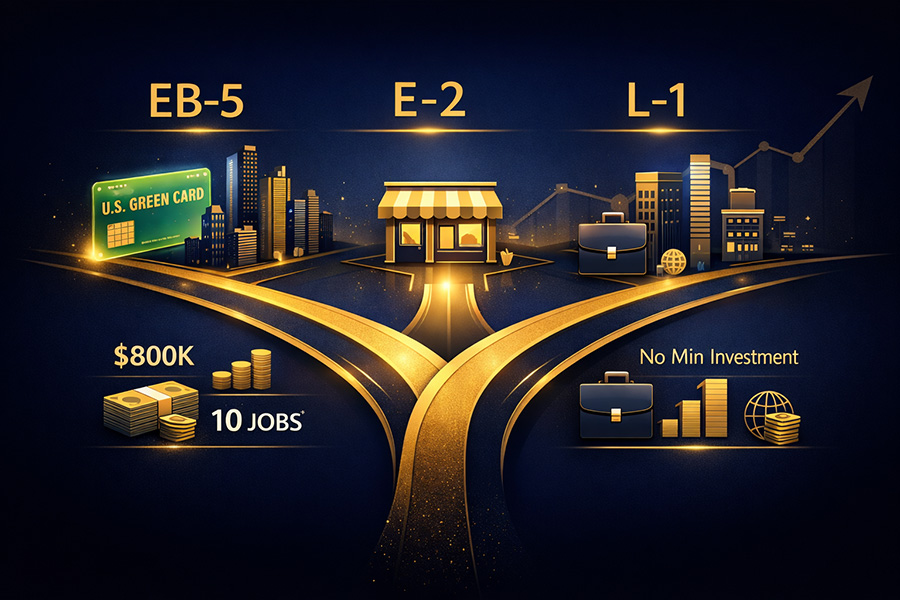
The EB‑5 program is an immigrant visa that leads directly to a green card. To qualify, you must invest $800,000 in a rural or high‑unemployment Targeted Employment Area (TEA) or $1.05 million elsewhere and create at least 10 full‑time U.S. jobs. Unlike other visas, EB‑5 does not require you to manage a business personally; you can invest through a regional center that handles operations. This path is open to nationals of any country and grants conditional residency for you, your spouse and unmarried children under 21. However, processing times can be long and you will need to keep your capital at risk until your conditions are removed.
E‑2: Entrepreneurial Flexibility Without a Green Card
The E‑2 Treaty Investor visa is a nonimmigrant option designed for citizens of countries that have bilateral treaties with the United States. The investment requirement is a “substantial” amount—typically around $100,000 or more—but there is no fixed minimum. You must own at least 50 % of the business or maintain control and actively direct its operations. E‑2 visas can be renewed indefinitely as long as the enterprise remains active and profitable. It offers quick entry and the ability to bring your family, but it does not provide a direct path to a green card; if permanent residency is your goal, you will need to transition to another category later.
L‑1: For Company Transfers and Managers
The L‑1 visa is designed for employees of multinational companies who are being transferred to a U.S. office. There are two subcategories: L‑1A for executives and managers, and L‑1B for workers with specialized knowledge. To qualify, you must have worked for the company abroad for at least one continuous year within the past three years and take on an executive, managerial or specialized role in the U.S. The L‑1 requires no personal investment, but it’s tied to your role within the company. Visas are initially granted for up to two or three years and can be extended to a maximum of seven years for L‑1A. The visa is dual intent, meaning you can apply for a green card while on L‑1 status, often through the EB‑1C category for multinational managers.
Side‑by‑Side Comparison
| Feature | EB‑5 | E‑2 | L‑1 |
|---|---|---|---|
| Visa Type | Immigrant (Green Card) | Nonimmigrant (Temporary) | Nonimmigrant (Dual intent) |
| Minimum Investment | $800K in TEA $1.05M elsewhere | Substantial, typically $100K+ | None (role‑based) |
| Job Creation | Requires 10 full‑time U.S. jobs | Business must not be marginal; no specific number | Not required |
| Nationality Eligibility | Any country | Treaty countries only | Any country (subject to company transfer) |
| Role in Business | Passive or active (via regional center or direct) | Active ownership and management | Manager/executive or specialized employee |
| Path to Green Card | Direct | Indirect (requires transition) | Through EB‑1C or other category |
| Processing Time | Longer; multiple steps | Generally faster | Moderate; depends on petition |
| Validity & Renewal | Leads to permanent residency | 2‑5 year visa, renewable indefinitely | Up to 7 years for L‑1A; then switch to another status |
Choosing the Right Path
Your choice depends on your goals and circumstances. If you have the capital and want a direct route to permanent residency, the EB‑5 program offers security and the ability to live and work anywhere in the United States. Entrepreneurs from treaty countries who prefer a smaller investment and hands‑on business control may opt for the E‑2 visa, knowing that they will need to plan a later transition if permanent residency is desired. Executives and managers who are expanding multinational companies into the U.S. will find the L‑1 route attractive, particularly because it doesn’t require a personal investment and provides a potential path to a green card through the EB‑1C category.
Key Takeaways
- EB‑5 is the only investment visa that directly grants a green card but requires a significant investment and job creation.
- E‑2 offers flexibility and lower capital requirements but is limited to citizens of treaty countries and does not itself provide permanent residency.
- L‑1 is intended for intra‑company transfers; it depends on your corporate role rather than investment and can lead to permanent residency through the EB‑1C category.
- Your situation—including nationality, available capital, business plans and immigration timeline—should dictate which visa you pursue.
By understanding the core differences among EB‑5, E‑2 and L‑1, you can select the path that aligns best with your investment goals and personal circumstances as we approach the end of 2025.