South America’s EB-5 Market Is Entering Its Sharpest Demand Cycle in Years
For a long time, EB-5 conversations in South America were easy to underestimate. The region produced real investors, but it often sat outside the industry’s main spotlight, which remained fixed on the largest Asian markets. That is changing.
In early 2026, South America feels less like a secondary opportunity pool and more like a market that is moving into execution mode. The tone of inquiry has shifted. Families are not just asking what EB-5 is. They are asking whether the project already has an approved or well-positioned I-956F, whether rural strategy is still the smartest path, whether they can preserve flexibility for adjustment of status, and whether they can file in time to protect the case before the current window narrows.
That is an important distinction. Curiosity creates leads. Timing pressure creates decisions. What we are seeing now is much closer to the second category.
Why this cycle feels different
The South American EB-5 story in 2026 is not simply about more attention. It is about a better-informed kind of attention.
Investors from the region are entering the process with a clearer understanding of three realities. First, visa availability is favorable today, but that does not mean it will remain favorable indefinitely. Second, filing timing now matters in a more concrete way because the current protection window has an end date. Third, project readiness has become more important than marketing language.
That combination changes investor behavior. It shortens the period between initial inquiry and real diligence. It increases focus on documentation, source of funds preparation, and category strategy. And it rewards sponsors and advisers who can answer practical questions instead of offering generic reassurance.
Four forces are driving the South American surge
1. Current visa access still gives South American investors a strategic advantage
For most South American nationals, the immediate question is not how to survive an existing EB-5 backlog. It is how to use a still-favorable visa position intelligently before demand catches up. That changes the conversation dramatically.
When an investor is current, the decision framework becomes more sophisticated. Instead of focusing only on country caps or waiting lines, the investor can compare unreserved, rural, and high-unemployment strategies based on speed, project quality, filing readiness, family needs, and execution risk. In other words, the market becomes more selective, not less.
This is one reason South American demand deserves attention. A current market often moves faster once investors feel that their main obstacle is no longer visa scarcity, but whether they can choose and file correctly.
2. The September 2026 filing deadline is turning interest into action
The market is also being pulled forward by a deadline psychology that is very easy to understand. Investors do not want to spend 2026 merely researching. They want to file while the legal protection window is still open.
That creates a different type of client behavior. Some families who might have taken twelve months to study the market are now trying to compress the process into a few months. Others are moving earlier because they do not want to compete for the same limited set of credible projects in the second half of the year. The closer the market gets to late 2026, the more likely it is that project selection, subscription levels, and attorney bandwidth all become tighter.
For South American investors, this matters because many are entering at a moment when the market still feels open, but no longer feels leisurely.
3. The 2027 pricing risk is making delay look expensive
Another force behind the inquiry growth is the simple desire to lock in today’s economics while they are still available. Investors understand that delay is no longer neutral. Waiting may mean higher cost, fewer project options, or both.
That does not mean every inquiry will convert. But it does mean the mental calculation has changed. A family that was previously comparing EB-5 against other migration or capital allocation strategies may now view 2026 as a decision year rather than a planning year.
Once investors reach that conclusion, the question stops being whether to look seriously. The question becomes how fast they can prepare funds, documents, and family strategy without making avoidable mistakes.
4. USCIS process changes are rewarding project readiness
This may be the most important operational shift of all. In 2026, investors are paying much closer attention to whether the underlying project is actually ready for adjudication. That is a healthier market behavior.
The practical implication is straightforward. A project with stronger readiness, better documentation discipline, and more predictable adjudication positioning now has a meaningful advantage over a project that is merely attractive in a pitch deck.
This dynamic is especially important in a market like South America, where many investors are pragmatic and timeline-sensitive. They are often less interested in abstract branding and more interested in a clean answer to a very direct question: if I move now, what exactly am I buying in terms of immigration positioning, project quality, and time risk?
Which South American markets matter most right now
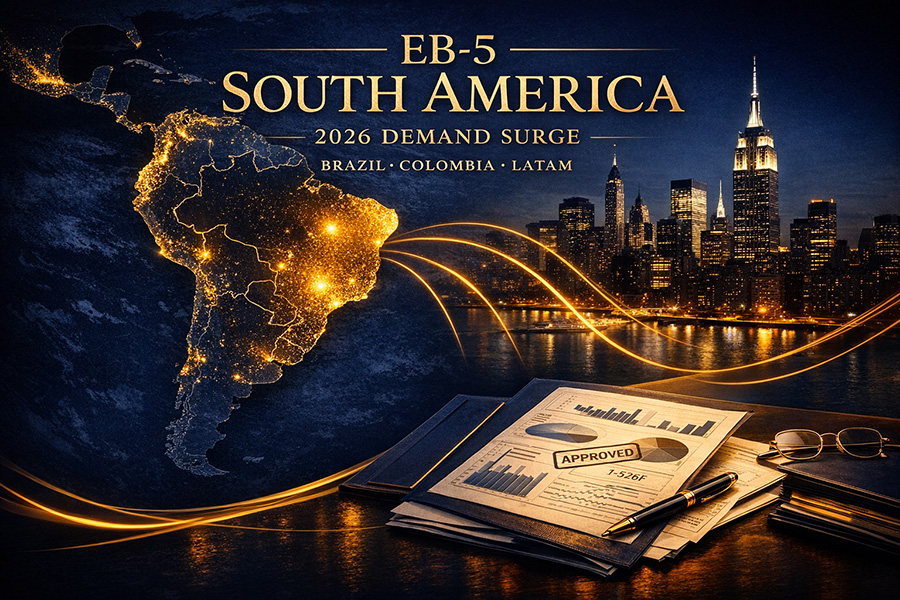
Brazil remains the anchor market in the region. It has scale, international familiarity, a deep base of globally mobile families, and a natural overlap with U.S. education, business expansion, and wealth diversification planning. Brazilian investors are often not treating EB-5 as a purely emotional relocation decision. Many view it as part of a broader family and asset strategy.
Colombia is one of the most interesting growth stories. It increasingly looks like a market that has moved beyond casual awareness and into structured participation. In practical terms, that means more serious screening, more disciplined source-of-funds preparation, and more investors approaching EB-5 as an organized process rather than an aspirational idea.
Venezuela, Peru, and Argentina add depth to the regional picture. The motivations vary by country and by family. For some, the driver is long-term mobility. For others, it is capital protection, education planning, or simply the desire to create a permanent option in the United States while still controlling the timing of a physical move. The important point is that the regional story is no longer concentrated in one country alone.
What South American investors are doing differently in 2026
The most notable shift is not just that more people are asking about EB-5. It is that better questions are being asked earlier.
Serious investors from the region increasingly want to know:
- Whether the project is rural, high-unemployment, or unreserved - and why that matters for their case.
- Whether the sponsor has a credible history of execution, not just fundraising.
- How much job cushion exists in the structure.
- Whether the capital stack is understandable and realistic.
- Whether the immigration documents and securities package are ready now, not someday.
That is a sign of market maturity. It also means weak offerings will have a harder time winning attention, especially when investors know they may only want to make this decision once.
Another pattern is the split between investors already present in the United States and those planning to process abroad. For families already in the U.S., speed and filing coordination can become central. For families outside the country, the process may feel more consular and document-driven, but timing still matters because project availability and filing windows do not wait for perfect conditions.
Where I think this market is going next
I do not expect South American demand to spread evenly across the EB-5 universe. I expect it to concentrate.
More capital will likely flow toward projects that combine three things: credible sponsor reputation, visible immigration readiness, and a category strategy that investors can explain to themselves in one sentence. That usually means a cleaner competitive position for projects that are already far along operationally, especially if they reduce uncertainty rather than add it.
I also expect a widening gap between early movers and late movers. Early movers still have the ability to compare structures carefully, build a proper source-of-funds file, and negotiate their path with discipline. Late movers may find themselves choosing from a narrower set of projects while racing the calendar.
And one more point matters: current does not mean permanently safe. The market should not assume that favorable visa availability today will eliminate future pressure if filings accelerate and adjudications turn into actual visa usage at scale. South American investors do not need panic. But they do need realism.
What serious investors should do now
If I were advising a South American family entering EB-5 in this environment, I would keep the message simple:
- Treat 2026 as a filing year, not just a research year. Waiting for total certainty can create more risk, not less.
- Start source-of-funds work early. In many cases, documentation readiness becomes the real bottleneck.
- Ask about I-956F status and project readiness immediately. Do not leave that question for the final stage of diligence.
- Do not confuse a current category with a guaranteed future advantage. Favorable conditions are valuable precisely because they may not last forever.
- Prioritize sponsor quality over marketing volume. In a tightening market, boring competence often beats exciting storytelling.
Bottom line
The South American EB-5 market is not just growing. It is getting sharper.
That is why the early 2026 increase in inquiries matters. It signals a market that is moving from passive interest to active selection. Investors are becoming more deadline-aware, more category-aware, and more demanding about execution quality. For sponsors and advisers, that is both an opportunity and a test.
The investors who move well this year are unlikely to be the ones chasing noise. They will be the ones who understand that in 2026, the real edge is not simply deciding to do EB-5. It is deciding early enough - and cleanly enough - to do it well.