
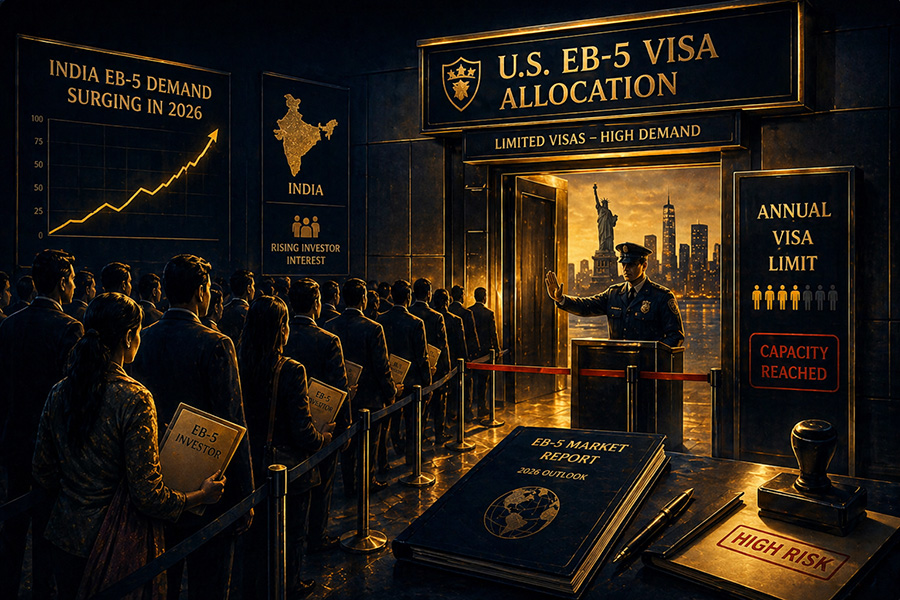
India EB-5 Shock 2026: From Momentum to Potential Cut-Off
For the past two years, India has been one of the most dynamic growth stories in the EB-5 market.
Demand has been rising. Investor profiles have become more sophisticated. Capital readiness has improved. For many, India looked like the next major opportunity.
In 2026, that story is starting to change.
What began as momentum is now turning into pressure. And pressure, in the EB-5 system, eventually leads to one outcome.
Cut-off dates.
From Opportunity to Acceleration
India’s rise in EB-5 has not been accidental. Several structural factors have been driving demand:
- Increased uncertainty around traditional work visa pathways
- A growing base of high-income professionals already in the United States
- Greater awareness of EB-5 as a long-term immigration strategy
Unlike earlier cycles, this demand is highly organized. Investors are informed, capital is prepared, and decision timelines are shorter.
This creates speed. And speed changes how pressure builds in the system.
The Current Reality: Early Signs of Constraint
As of 2026, India is no longer a purely “open” EB-5 market.
Priority dates are already constrained in unreserved categories, and movement has slowed significantly compared to earlier expectations.
At the same time, demand has not slowed.
This is the first signal that the system is beginning to tighten.
Why India Is Reaching This Point Faster
India is not repeating China’s trajectory exactly. It is compressing it.
Three factors explain why:
1. Concentrated Demand
A large portion of EB-5 demand from India is coming from investors already inside the U.S. system. This means faster filings, faster transitions, and quicker conversion into visa demand.
2. Strategic Use of EB-5
Indian investors are increasingly using EB-5 not as a last resort, but as a planned pathway. This changes behavior from reactive to proactive.
3. Faster Decision Cycles
Information flows faster. Market awareness is higher. Investors are not waiting years to decide - they are acting within months.
Together, these factors accelerate the demand curve.
The Risk No One Wants to Acknowledge
The biggest misconception in the market today is that India still has time.
It does not.
When demand builds quickly in a system with fixed visa supply, the adjustment is not gradual. It is sudden.
Cut-off dates appear. Movement stops. And new investors enter the queue under different conditions.
By the time a cut-off becomes obvious, the advantage of acting early has already disappeared.
What Happens If a Cut-Off Appears
If India moves into deeper retrogression, the implications are immediate:
- Longer waiting times for new applicants
- Reduced flexibility in choosing projects and timelines
- Loss of timing advantages for investors who delay
This does not stop EB-5 from working as a strategy.
It changes when it works.
Reserved Categories: Temporary Buffer, Not Permanent Solution
Reserved EB-5 categories still provide an alternative pathway. They remain current and are absorbing a significant portion of new demand.
But this should not be misunderstood as a long-term guarantee.
As more Indian investors move into these categories, pressure will eventually shift there as well.
The absence of a backlog today does not eliminate the possibility of one tomorrow.
How Sophisticated Investors Are Responding
Investors who understand how quickly market conditions can change are already adjusting their strategies.
- Acting earlier in the cycle to secure priority dates
- Focusing on categories with current availability while they remain open
- Reducing decision delays to avoid entering a tightening market
- Structuring applications efficiently to align with current processing conditions
This is not about reacting to panic. It is about recognizing how fast momentum can turn into constraint.
Bottom Line
India in 2026 is no longer just a growth story.
It is the first major pressure point in the next phase of the EB-5 market.
The shift from momentum to constraint has already begun.
The only question is how quickly it becomes visible to everyone else.
For investors, timing is no longer a secondary factor.
It is the strategy.