May 2026 EB-5 Warning: Demand Is Rising, and Retrogression May Follow
The May 2026 Visa Bulletin does not look alarming at first glance. Movement appears controlled. Categories remain largely stable. There is no dramatic disruption.
But for experienced EB-5 investors, this is exactly the kind of moment that requires closer attention.
Because the most important signal in the May update is not what changed on the surface.
It is what is building underneath.
Demand Is Accelerating - Quietly but Consistently
Across the EB-5 market, demand is rising faster than most public data suggests.
This is particularly visible in two segments:
- Investors already in the United States, especially on H-1B, L-1, and F-1 visas
- Markets that were previously underrepresented but are now entering the EB-5 pipeline
Unlike previous cycles, this demand is not always immediately reflected in the Visa Bulletin. There is a lag between filings, approvals, and actual visa usage.
That lag is where risk begins to form.
Why the Visa Bulletin Still Looks Stable
The current stability in the Visa Bulletin is not evidence of balanced demand.
It is the result of timing.
Visa allocation operates within annual limits, and the system adjusts based on how quickly those visas are used. Early in the cycle, when usage is still catching up to filings, categories can appear more open than they actually are.
This creates a temporary window where:
- Priority dates move forward
- Categories remain current
- Filing conditions look favorable
But this window exists because demand has not yet fully translated into visa consumption.
The Key Signal in May 2026
The May Visa Bulletin introduces a subtle but important shift in tone.
Instead of signaling improvement, it reflects increased monitoring of demand levels and visa usage.
This is typically how retrogression begins - not with a sudden shock, but with early acknowledgment that demand is approaching system limits.
In EB-5, retrogression does not arrive unexpectedly. It builds quietly until the system has no choice but to adjust.
Where Pressure Is Building First
The pressure is not evenly distributed across the market.
Three areas are particularly important:
1. India Demand
India continues to show increasing engagement with EB-5, especially from professionals already in the U.S. system. This demand is structured, well-capitalized, and moving quickly.
2. Reserved Categories
Reserved EB-5 remains current, but filings are accelerating. These categories are still in an early demand phase, which means pressure is not yet visible in cutoff dates.
3. Adjustment of Status Pipeline
More investors are using concurrent filing strategies. This accelerates the transition from petition to visa usage, compressing timelines and increasing demand pressure within the same fiscal cycle.
Why Retrogression Becomes More Likely
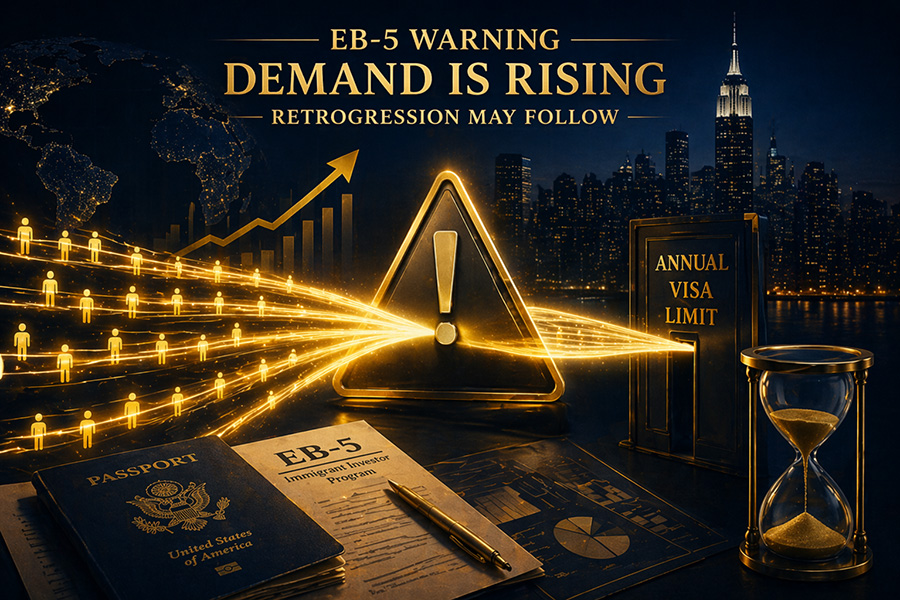
When demand rises while visa supply remains fixed, the system must adjust.
There are only two ways it can do so:
- Slow processing - which has limits
- Move priority dates backward - which is retrogression
Given current trends, retrogression is not a remote scenario. It is a logical outcome if demand continues at its current pace.
What This Means for Investors Right Now
The May 2026 update is not a warning to panic. It is a signal to act with precision.
Investors who understand how timing works in EB-5 are already adjusting their approach.
- Securing priority dates earlier while conditions remain favorable
- Focusing on categories that are still current before pressure becomes visible
- Preparing complete and well-structured applications to avoid delays
- Aligning decisions with the 2026–2027 policy timeline to reduce long-term risk
The goal is not to react after retrogression appears.
The goal is to move before it becomes visible.
Bottom Line
The May 2026 Visa Bulletin is not a confirmation of stability.
It is an early signal of rising demand.
And in EB-5, rising demand without increased supply leads to only one outcome over time.
Retrogression.
The window is still open.
But it is no longer wide.